
Moving From Illinois to Northwest Indiana: What Buyers Actually Save in 2026
How Much Do Illinois Buyers Actually Save Moving to Northwest Indiana in 2026?
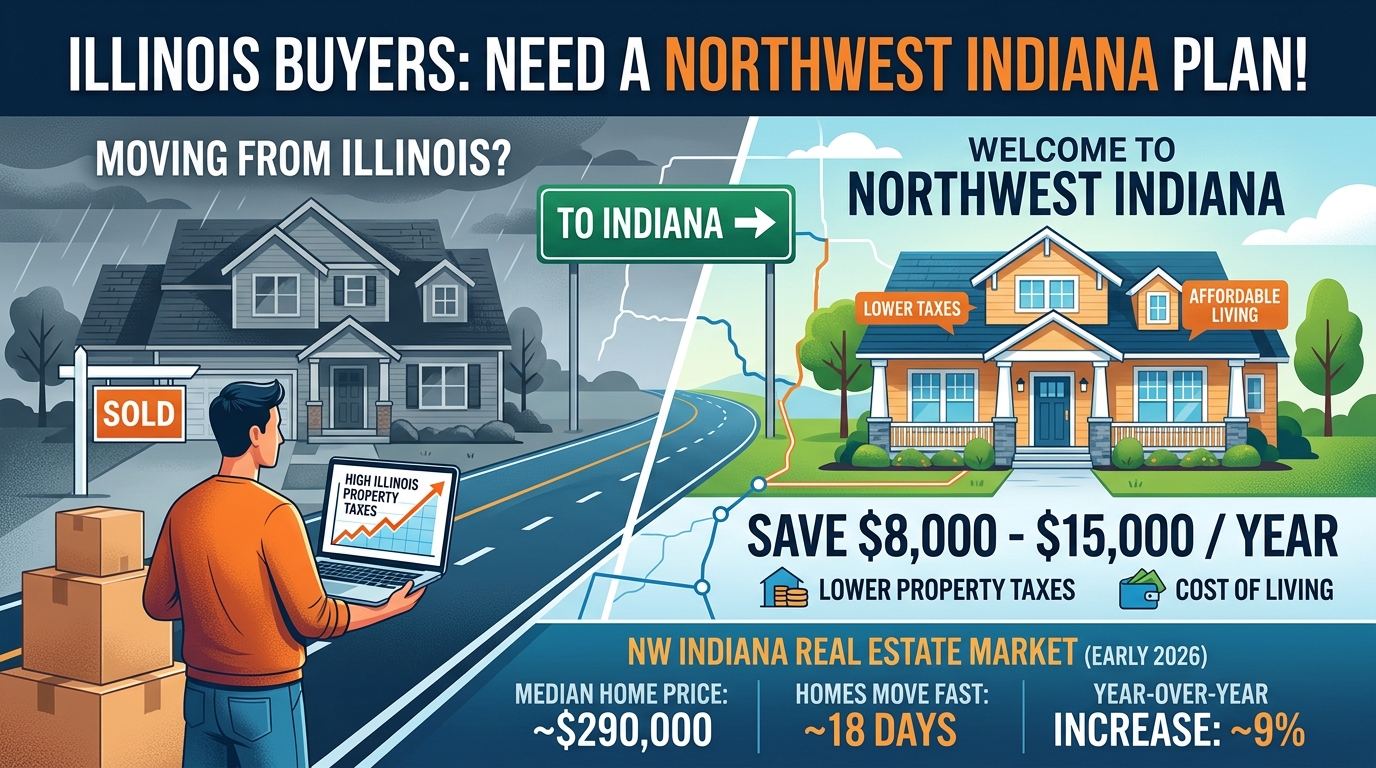
Households relocating from Chicago-area suburbs to Lake, Porter, and La Porte counties are commonly saving $8,000 to $15,000 a year in property taxes and overall cost of living, largely because Indiana assessed values and homestead deductions run well below what many Illinois homeowners are used to paying. The median Northwest Indiana single-family home sold for around $290,000 in early 2026, up roughly 9% year over year, and homes are moving in about 18 days on average. That combination of savings and speed means Illinois buyers need a clear, Indiana-specific plan before they start touring, not after they've already fallen behind on offers.
By the Constellation Home Sales Team | August 25, 2026
Every week, I talk to a family in Orland Park, Naperville, or Tinley Park who just opened their Cook County or Will County tax bill and started doing math on a map. They're not wrong to. Northwest Indiana has added an average of roughly 1,300 new residents a year through domestic migration since 2018, and a meaningful share of that demand is coming directly from Illinois.
I've worked both sides of this move for over two decades, which means I'm not guessing at what a Chicago-area budget looks like next to a Lake County one. Here's what the numbers actually say, and what's genuinely different about buying a house once you cross the state line.
This isn't a hypothetical exercise for most of the people I talk to. It's usually triggered by a specific moment: a reassessment notice that landed harder than expected, a second child on the way, or a retirement timeline that suddenly makes a lower cost of living feel less like a someday plan and more like a next-year decision. Whatever the trigger, the questions that follow are almost always the same three: how much would we actually save, how fast would we need to move, and what's different enough about buying in Indiana that we'd need to relearn.
Why Illinois Households Are Choosing Northwest Indiana in 2026
The pull isn't complicated. It's mostly one line item on a monthly budget.
Property tax bills in many Chicago-area suburbs commonly run $11,000 to $18,000 a year or more, depending on the municipality, home value, and any recent Cook County reassessment. In Northwest Indiana, a comparable home typically carries a tax bill in the $2,500 to $5,500 range, depending on the county, township, and whether the homestead deduction has been applied.
That gap is the whole story for most of the buyers I work with. Indiana's Standard Homestead Deduction removes $40,000 from your home's assessed value for 2026, and a Supplemental Homestead Deduction removes another 40% of what's left. On top of that, homeowners automatically receive a 10% tax credit, capped at $300, applied straight to the bill. Stack those together and you can see why families report saving somewhere between $8,000 and $15,000 a year once they've made the move, factoring in both taxes and the broader cost of living.
You'll still want your own number, not a metro-wide average. Every township sets its own rate, and every home carries its own assessed value. This is exactly the kind of calculation I run for clients before they write an offer, not after.
It's not only about taxes, either. Households making this move consistently point to lower auto insurance, lower utility rates, and a materially lower cost of everyday living once they're settled. None of that shows up on a listing sheet, so it's easy to underestimate until you've actually built the budget side by side. I walk clients through that full comparison before they ever schedule a showing, because the tax line is usually the headline number and the rest of the budget is where the real decision gets made.
The Real Numbers: Home Prices, Speed, and What's Actually Available
Savings on taxes only matter if you can find a home that fits your budget and your timeline, and right now Northwest Indiana is not a slow market.
Here's what the numbers look like across the towns I work in most:
Munster— median sale price near $375,000, with roughly 2.5 months of supply, which is tight
Crown Point— median sale price in the $355,000–$365,000 range, with some homes going pending in about eight days
Schererville— typical homes stay on market about 43 days and draw around two offers
Valparaiso— median sale price between $280,000 and $340,000, with new subdivisions adding inventory on the west side
Merrillville, Highland, and Hobart— the more accessible entry points for buyers who want newer construction without Munster or Crown Point pricing
Across the region, homes are selling in about 18 days on average, well under the national pace. If you're coming from an Illinois market where you had time to think an offer over for a week, that adjustment alone can cost you a house if nobody warned you about it.
Illinois buyers also tend to arrive with a stronger budget relative to local pricing, which sellers and listing agents notice. That's an advantage if you're prepared to move quickly with financing already lined up. It's a disadvantage if you're still comparing this market to the one you left.
One more thing worth planning around: your current Illinois lender may not be licensed to close a loan on an Indiana property, and even if they are, they may not have local relationships with the title companies and inspectors who can move a Northwest Indiana transaction at the pace this market demands. Lining up an Indiana-savvy lender before you start touring homes, not after you've found one, is one of the simplest ways to protect your timeline.
What's Actually Different About Buying a House in Indiana
This is the part that catches most Illinois transplants off guard, and it has nothing to do with money.
Indiana is not an attorney-closing state. Your closing runs through a title company or escrow agent, not through the kind of attorney-managed process you may be used to. An attorney can still review your contract if you want one involved, however the closing mechanism itself works differently here, and that changes your timeline and who you're calling with questions.
You'll also encounter two separate documents that both get loosely called "the disclosure," and they're not the same thing. The Seller's Residential Real Estate Sales Disclosure covers the property's condition — foundation, mechanical systems, roof, water and sewer, known hazards — and you'll see it before you make an offer. Separately, the Sales Disclosure Form (State Form 46021) is a property tax filing submitted to the county auditor at closing, with a small filing fee that varies by county. Confirm the current filing fee with your title company rather than assuming it matches what a neighbor paid.
Indiana has no state real estate transfer tax. Form 46021 is the closest equivalent administrative step, however it's a tax-assessment filing, not a transfer tax, so don't budget for it the way you might have budgeted for a transfer tax somewhere else.
None of this is complicated once someone walks you through it once. It's just different enough from what you already know that guessing gets expensive.
If you want to see what this looks like against your own numbers rather than a countywide average,Northwest Indiana's housing market conditions shift by township and price point, and Crown Point's new construction pipeline is one of the clearer examples of where that new supply is actually landing this year.
Frequently Asked Questions
How much less are property taxes in Northwest Indiana compared to Chicago's suburbs?
Many Chicago-area households pay $11,000 to $18,000 or more per year, while a comparable Northwest Indiana home commonly runs $2,500 to $5,500 once Indiana's homestead deductions are applied. Your exact figure depends on the township, the assessed value, and whether you've filed for the homestead deduction, so treat these as ranges rather than a guarantee.
Do I need a real estate attorney to buy a house in Indiana?
Indiana isn't an attorney-closing state, so your closing is handled by a title company or escrow agent rather than an attorney by default. You can still hire an attorney to review your contract if you want that extra layer, it's simply not the standard closing mechanism the way it is in Illinois.
Is Northwest Indiana a competitive market right now?
Yes. Homes across the region are selling in about 18 days on average, and towns like Crown Point and Schererville are seeing multiple-offer situations regularly. Coming in with financing already arranged matters more here than it may have in your previous market.
What's the Sales Disclosure Form, and is it the same as the seller's condition disclosure?
No, they're two different documents. The Seller's Residential Real Estate Sales Disclosure covers the home's physical condition, while State Form 46021 is a separate tax filing submitted to the county auditor at closing. Confirm the current filing fee for Form 46021 with your title company, since it varies by county.
Is now a good time for an Illinois buyer to start looking in Northwest Indiana?
If the tax and cost-of-living math already makes sense for your situation, waiting mostly means competing against more buyers making the same discovery. Get pre-approved, understand your target towns' pace, and go in with a plan built around Indiana's process rather than Illinois habits.
Every family's savings number looks a little different once you factor in your specific home value, your target township, and where you're coming from in Illinois. If you want to see what the real math looks like for your situation, text or call 630-912-9129 and I'll run the numbers against actual Northwest Indiana listings instead of a metro-wide average.
About the Constellation Home Sales Team
The Constellation Home Sales Team — Steve Roake and Kimberly Genovese — has closed more than 615 transactions worth over $113 million across Chicago's southwest suburbs and Northwest Indiana. Licensed since 2003 and operating under Keller Williams Preferred Realty, the team specializes in probate and estate sales, expired listings, negotiation, and divorce and life-transition sales, with a track record of selling homes at 101% of list price against a 97.7% MLS-wide average. Connect with the team at freedomgroupglobal.com or 630-912-9129.
