Indiana 2026 Property Tax Changes: NWI Homeowners Guide
Indiana Taxes, NWI Real Estate, Homeownership
Indiana’s 2026 Property Tax Changes: What NWI Homeowners Need to Know for 2027 Bills
Major changes are coming to Indiana property taxes that will show up on tax bills payable in 2027. If you own a home in Lake, Porter, or La Porte County, understanding how the state’s tax caps, the new 10% homestead credit, and evolving deductions fit together can help you budget wisely, protect your equity, and time your next move with confidence.
1. A quick refresher: Indiana’s property tax caps still set the ceiling
Before diving into the new credit and deduction changes, it helps to remember how Indiana’s property tax caps work. These caps were added to the state constitution to keep property taxes from rising too quickly, especially in fast-growing or higher-tax communities like many in Northwest Indiana (NWI).
1% cap of gross assessed value for owner-occupied homes (your primary residence)
2% cap for rental properties and agricultural land
3% cap for commercial and industrial property
These are often called “circuit breaker” caps. If your calculated property tax bill is higher than the cap amount, it is “broken” down to the cap and you don’t pay the excess. This system has provided meaningful relief to homeowners, but it has also limited revenue for schools and local governments, especially in places with rising home values like parts of Lake and Porter Counties.
💡 Key point: The new 10% homestead credit does not replace the 1% cap. The cap still limits your maximum bill; the credit then reduces what you actually pay, in most cases after the cap is applied.
2. The new 10% homestead credit: what it is and when you’ll see it
What is the 10% homestead credit?
Beginning with property tax bills payable in 2027 (based on your January 1, 2026 assessment), Indiana is adding a new Supplemental Homestead Credit for homeowners who already receive the homestead deduction. This is sometimes referred to as the “10% credit.”
The credit equals the lesser of 10% of your property tax liability or $300.
It is calculated after other deductions and the circuit breaker cap are applied, then subtracted from what you owe.
In plain language: once your tax bill is figured using the usual process, the state will knock off up to 10%, but no more than $300, for qualifying owner-occupied homes. You do not need to file a separate application; if your homestead deduction is on file, the credit is automatic.1
When will the credit appear on my bill?
For Northwest Indiana homeowners, you’ll first see this new credit on your spring 2027 property tax bill (the “2026 pay 2027” cycle). On your bill, it will typically show up as a separate line item—often labeled something like “Supplemental Homestead Credit” or “10% Homestead Credit”—reducing the total amount due.
📌 Key takeaway: The 10% credit is not part of your 2025 pay 2026 bill. It starts with the bills due in 2027, based on your 2026 assessment.
3. Who qualifies for the new homestead credit?
Eligibility for the 10% credit is tied directly to the existing homestead deduction. If you receive that deduction now, you are generally set to receive the new credit as well. In most cases, you qualify if:
The property is your principal residence as of January 1 of the assessment year, and
You have properly filed for and been granted the homestead deduction with your county auditor.
You do not qualify if:
The property is a rental, second home, or investment property, or
You never filed for a homestead deduction, or it was removed (for example, after a move or change in ownership).
💡 Pro tip for NWI sellers and buyers: If you’re buying in Lake, Porter, or La Porte County in 2026, make sure the homestead deduction is filed promptly after closing so you’re positioned to receive the 10% credit on the 2027 bill.
4. The phased shift away from flat-dollar deductions through 2031
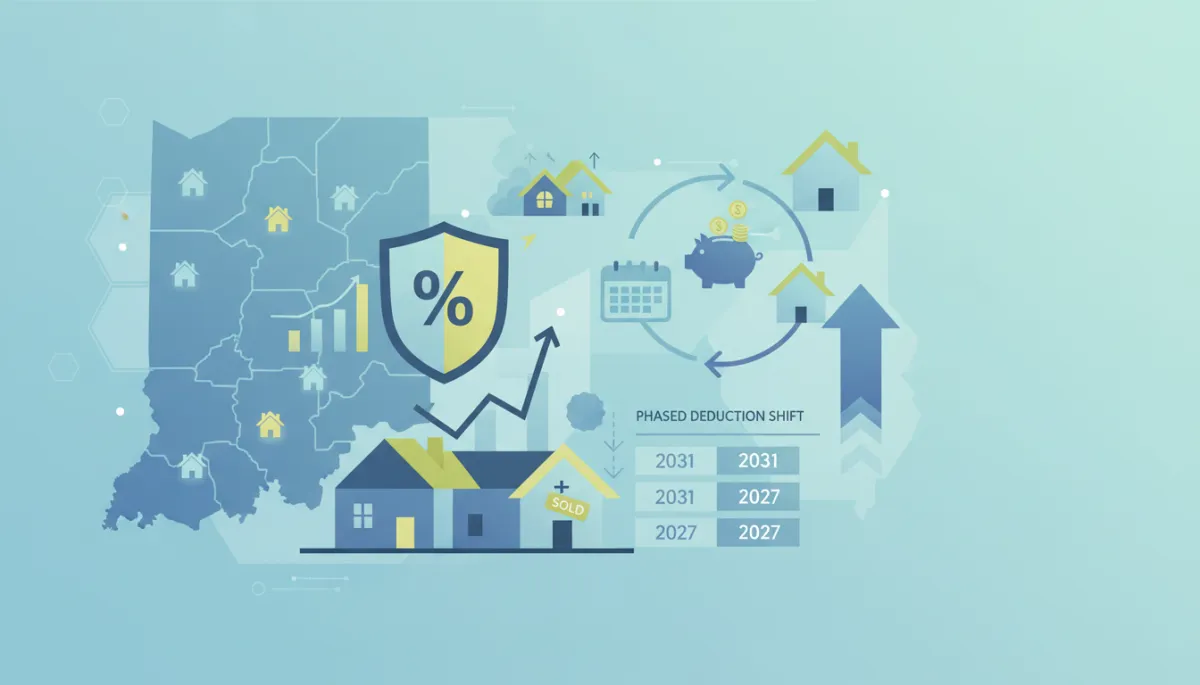
Alongside the new credit, Indiana is reshaping how much of your home’s value is actually taxed. Historically, homeowners relied on a combination of a flat-dollar standard homestead deduction plus a percentage-based supplemental homestead deduction. Starting with the 2026 assessment (payable in 2027), the state is gradually shifting more weight to the percentage-based deduction and less to the flat amount.2
For 2026 pay 2027, the standard deduction is $40,000, and the supplemental deduction is 46% of the remaining assessed value after that standard deduction.3
Each year through 2031, the supplemental percentage increases, until about two-thirds (66.7%) of your homestead’s gross assessed value is non-taxable—meaning only one-third is actually taxed.2
Over time, this favors homeowners with higher-value properties a bit more, because a percentage-based deduction grows as values rise. But it also helps moderate tax increases for most NWI homeowners, especially as assessments climb with the market.

Reviewing deductions and credits yearly helps NWI homeowners avoid surprises at tax time.
5. Rising assessments in 2026: why checking your value matters in NWI
For the assessment date of January 1, 2026, Indiana has already signaled that statewide gross assessed values are increasing by about 11% on average, reflecting recent sale prices and updated cost tables.4 In many Lake and Porter County neighborhoods—especially areas closer to Chicago commuters—market appreciation could be higher than the state average.
Those higher assessments feed directly into your 2027 tax bill. While the 1% cap, larger supplemental deductions, and the new 10% credit will soften the blow, it is still critical to:
Review your Form 11/assessment notice when it arrives from your county (usually in the spring).
Compare the assessed value to recent sales of similar homes in your neighborhood—especially in places like Crown Point, Munster, Valparaiso, Chesterton, and Michigan City, where prices have moved quickly.
File an appeal by the deadline if you believe your assessment is significantly above market value. A successful appeal can lower your tax base for years.
💡 Local tip: Lake, Porter, and La Porte Counties participate in Indiana’s four-year cyclical reassessment process, meaning about 25% of parcels are closely reviewed each year. Even if you weren’t in the last cycle, 2026–2027 could be your turn—another reason to watch your mail carefully.
6. Why your homestead deduction status is more important than ever
The homestead deduction has always been valuable, but with the new 10% credit layered on top, losing that deduction can now mean missing out on two forms of relief at once: the deduction itself and the credit that depends on it.
How to confirm you’re getting the homestead deduction
Look at your most recent property tax bill for a line labeled something like “Homestead Deduction” or “Standard Homestead Deduction” and “Supplemental Homestead Deduction.”
Use your county’s online property tax portal (Lake, Porter, and La Porte all offer online search tools) to view your parcel and verify deductions and credits are listed.
If the homestead deduction is missing and your home is your primary residence, contact your county auditor’s office right away. You may be able to file a late application or correct an error, but timing is crucial—applications usually must be in place by mid-January of the year following the assessment to apply to that bill cycle.3
⚠️ Warning: If you move out and convert your home to a rental but leave the homestead deduction on, you can face penalties and back taxes. Always update your status after a sale or change in use.
7. How these changes affect NWI homeowners’ budgets, equity, and sale timing
Budget planning: what to expect for 2027 and beyond
For many Lake, Porter, and La Porte County homeowners, the combination of higher assessments, larger supplemental deductions, and the new 10% credit will mean:
A modest increase in the tax bill if your assessed value jumps more than the relief can offset; or
A relatively flat bill—or even a slight decrease—if your value increase is closer to the state average and your local tax rates remain stable.
If your mortgage is escrowed, your lender will adjust your monthly payment once 2027 bills are known. It’s smart to set aside a small cushion in 2026 in case escrow needs to be increased, especially if you’ve seen strong price appreciation in your neighborhood.
Equity and sale timing: does the 10% credit change when you should sell?
The new 10% homestead credit is tied to whoever owns and occupies the home as their primary residence when the tax is assessed and billed. That means:
If you sell before the 2027 bills are issued, the buyer will usually benefit from the credit once they file their homestead deduction, not you.
If you stay through 2027 and beyond, the credit will continue to reduce your annual housing costs, which can help retirees and fixed-income households remain in their homes longer.
In most cases, the credit alone is not large enough to justify delaying a sale if you’re otherwise ready to move. A maximum of $300 per year, while helpful, is small compared with the impact of mortgage rates, sale prices, and moving costs. However, it may influence your decision if you are on the fence and planning to stay just one more year to build equity or pay down debt.
📌 Seller strategy: If you’re listing a home in Lake, Porter, or La Porte County after the 10% credit takes effect, highlighting “reduced property tax bill thanks to new Indiana homestead credit” in your marketing can reassure buyers about long-term affordability.
8. Step-by-step: how NWI homeowners can assess their own situation
Step 1: Confirm your current assessed value and deductions
Visit your county’s online property portal (Lake, Porter, or La Porte) and locate your parcel using your address or parcel number.
Note your gross assessed value for 2026 and the net assessed value after deductions.
Confirm that the Standard Homestead Deduction and Supplemental Homestead Deduction are listed, along with any senior, disabled, or veteran credits you may qualify for.
Step 2: Estimate your 2027 bill with the 10% credit
While only your county can calculate your exact bill, you can get a rough estimate by:
Looking at your current total tax bill and noting the rate (total tax divided by net assessed value).
Applying the expected 46% supplemental deduction and $40,000 standard deduction to your 2026 gross assessed value to estimate your new net assessed value.
Multiplying that net value by your current tax rate to get a ballpark pre-credit tax amount (remember, the 1% cap may still limit this).
Taking 10% of that amount, up to $300, and subtracting it to approximate your post-credit bill.
For a more precise projection, keep an eye on Indiana’s Property Tax Transparency Portal, which allows taxpayers to compare current bills with scenarios under proposed rate changes.5 Many NWI residents are already using this tool to understand potential school referendums and local rate shifts.
Step 3: Factor taxes into your broader financial and housing plans
Retirees and fixed-income owners in NWI may want to explore the state’s option to defer up to $500 per year in property taxes (up to $10,000 total) until the home is sold—another tool created to help people stay in their homes longer.5
Growing families considering a move within Lake, Porter, or La Porte Counties should compare not only list prices, but also effective property tax costs after the new credit. Some school districts may seek additional funding through referendums, which could raise local rates even as statewide relief expands.
9. What this means specifically for Lake, Porter, and La Porte County homeowners
While state law applies uniformly, the impact of these changes will feel a bit different in each NWI county:
Lake County: With some of the region’s highest tax rates and fastest-rising values in certain communities, the 1% cap and 10% credit will be especially important. Many homeowners already hit the cap; in those cases, the new credit can still offer additional relief on top of the cap reduction, depending on how the bill is structured locally.
Porter County: Strong demand in towns like Valparaiso and Chesterton has pushed values higher. Here, the phased increase in percentage-based deductions through 2031 will help counteract rising assessments, while the 10% credit provides an extra buffer for owner-occupants.
La Porte County: With a mix of lakefront, rural, and in-town properties, the impact will vary neighborhood by neighborhood. In areas where values have been slower to climb, the credit and larger deductions may translate into more noticeable tax savings relative to income.
💡 Remember: Indiana’s median property tax rate for owner-occupied homes is around 0.77% statewide.6 In higher-tax NWI communities, the gap between the “headline” rate and what you actually pay after caps, deductions, and credits can be significant—another reason to look at your net bill, not just the gross rate.
10. Final thoughts: how to stay proactive, not reactive
Indiana’s 2026 property tax reforms—especially the 10% homestead credit and the shift toward larger percentage-based deductions—are designed to cushion homeowners from rapid assessment increases. For NWI residents in Lake, Porter, and La Porte Counties, these changes will intersect with local market trends, school funding decisions, and neighborhood growth in unique ways.
To make the most of these reforms:
Check your assessed value and appeal if it’s out of line with recent comparable sales.
Confirm your homestead deduction is properly in place so you qualify for both deductions and the new credit.
Plan your budget with a modest cushion for 2027, even with the new relief measures.
Weigh selling decisions based on your broader financial and lifestyle goals, not just the credit, while recognizing that the new rules can make staying put slightly more affordable each year.
Property taxes may never be exciting, but understanding how Indiana’s caps, deductions, and new 10% homestead credit work together can turn a potential surprise into a predictable line item in your NWI household budget—and help you make smarter decisions about when to buy, sell, or simply stay and enjoy your home.
Sources: Indiana House Republicans – “New tax cuts for Hoosiers in 2026”5; Indiana Department of Local Government Finance memos and presentations on 2026–2031 deductions and credits2,3; Indiana Chamber of Commerce – 2026 real property assessment update4; DLGF cyclical reassessment guidance; Kiplinger state tax guide for Indiana6.
