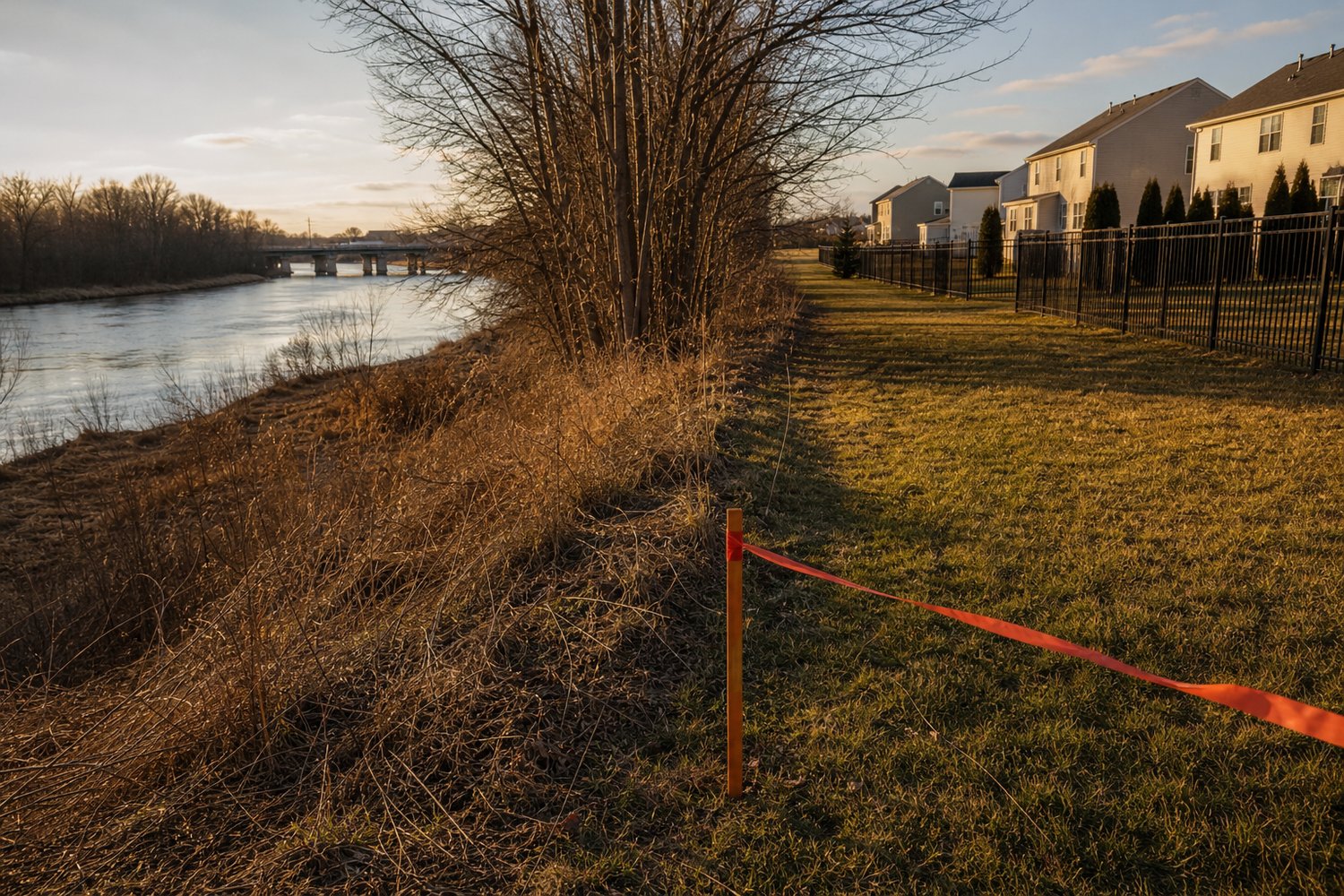
Fox River in North Aurora Property Checks Before an Offer
The decision in front of you is whether this specific parcel carries risk, not whether the river is nearby. Pull its FEMA flood-zone status, compare it with Kane County's drainage map, request repair and sump pump records, and get written insurance answers before you write an offer. Proximity alone proves nothing either way.
Fox River in North Aurora Property Checks Before an Offer
What should you check on a home near the Fox River in North Aurora?
Start with the parcel, not the neighborhood. For a home near the Fox River in North Aurora, confirm its FEMA flood-zone status, compare that with Kane County's drainage map, collect repair and sump pump records, and get written insurance answers before you offer. Being near the river is a reason to verify, not proof of a problem.
Key Takeaways
Single-family and other home types sold within Aurora city limits from August to October 2026 had a median sale price of $344,760 and a median of 10 days from listing to going under contract, so your checks need to be lined up before a good listing appears.
A FEMA flood map and a Kane County drainage map answer different questions, and a parcel outside a mapped floodplain can still have ponding, runoff, or seepage issues.
A standard homeowners policy does not cover flood damage, including groundwater, rain runoff, and snowmelt, so flood coverage has to be evaluated separately.
Whether a lender requires flood insurance depends on the property's flood-zone designation, while voluntary coverage is a separate buyer decision.
A North Aurora mailing address does not tell you whether the parcel sits in the Village of North Aurora, the City of Aurora, or unincorporated Kane County.
Is the home in a mapped floodplain, and what does the county drainage map add?
Check both maps for the exact parcel. FEMA's Flood Insurance Rate Map speaks to regulatory floodplain status, and Kane County's drainage maps are planning-level illustrations of where stormwater may accumulate and how it flows. Neither one is a complete history of a specific basement.
Why a clean FEMA map is not the end of the question
The county shows FEMA regulatory floodplain boundaries on its drainage maps as a courtesy, but the drainage maps themselves are a different tool. A parcel outside a FEMA-mapped floodplain may still warrant questions about backyard ponding, overland runoff, basement seepage, or local drainage structures. That is an interpretation of how the county separates the two products, and it is the reason to look at both.
Kane County Water Resources staff keep current and historic FEMA maps and floodplain studies, and the county's floodplain maps and resources page is a good place to begin. Kane County's hazard mitigation plan describes the Fox River floodplain in North Aurora as designated for public open space. According to the Illinois Emergency Management Agency's Kane County plan, that is a planning description. It does not tell you the status of any one home, and it does not mean every nearby property has the same exposure or the same insurance situation.
Confirm the jurisdiction first
A North Aurora mailing address does not by itself establish who governs the parcel. It could fall within the Village of North Aurora, the City of Aurora, or unincorporated Kane County. Floodplain, stormwater, permit, and drainage responsibilities can depend on which one applies. The City of Aurora's engineering division also keeps floodplain information and FEMA map materials for public review, which matters if the property sits near a municipal boundary.
Here is how the main sources divide the work:
Source | What it can tell you | What it can't tell you |
|---|---|---|
FEMA Flood Insurance Rate Map | Regulatory flood-zone designation for the parcel | Backyard ponding, runoff, or past basement seepage |
Kane County drainage map | Where stormwater may accumulate and flow | A parcel-specific determination or insurance status |
Seller records and permits | Repairs, drainage work, pump replacements, approved improvements | Unpermitted work or unreported problems |
Insurance agent and lender | Whether flood coverage is available or required, and what is excluded | Physical condition of the home |
What records should you ask for on a river-adjacent home?
Ask for a property-specific paper trail covering water, repairs, and maintenance. You are looking for evidence of what has happened at this address, not a general reassurance.
Prior flood or water-intrusion claims
Basement-repair invoices
Sump pump replacement records and details on any backup pump
Drain-tile or foundation-waterproofing work
Grading or excavation permits
Records for floodproofing or retaining structures
Who to ask, and what the answers do and don't prove
Your closing agent (a title company or a real estate attorney, whichever you choose) can help you review what is on record for the parcel. The seller can speak to repairs and claims, and your inspector can tell you what the house itself shows. Steve walks buyers through assembling this list before the offer, so nobody is scrambling during a short contingency window.
Be careful with one phrase in particular. A statement that a home "has never flooded" does not answer whether it has had basement seepage or sewer backup. Ask the question in pieces: river water, surface runoff, groundwater, sewer backup, and plumbing leaks.
A permit search helps, but it is not proof of a dry property. Permits can reveal approved improvements or drainage work. Unpermitted repairs, routine maintenance, and prior-owner work may show up only in seller records, municipal files, inspection findings, or insurer documentation.
How do you inspect a Fox River property for drainage problems?
Walk the lot and the foundation, ideally during or after wet weather, and ask your inspector to separate the possible water sources. Different causes can mean different exclusions, deductibles, and insurance products.
What to look for outside and in the basement
Standing water, soil erosion, or saturated ground near the foundation
Downspouts that discharge beside the house
Water in window wells
Efflorescence (a white, chalky residue) or musty odors in the basement
Patched foundation cracks
A sump pump that discharges toward the foundation or a neighboring lot
Ask the seller whether the home has a sump pump, a backup pump, or any other flood-control equipment, and ask to see how it is set up. Then ask your inspector to note the age and condition of what is there.
Treat the river as a reason to verify
Risk can vary a great deal with elevation, floodplain boundary, lot grading, drainage infrastructure, foundation design, basement layout, and any prior mitigation work. A home near the river may check out well, and a home farther away may not. The evidence that matters is the parcel's map status, its physical condition, its records, and a real insurance quote.
What should you ask an insurance agent and lender before you offer?
Ask for written answers on flood coverage before the offer becomes hard to change. A standard homeowners policy does not cover flood damage, and the Illinois Department of Insurance lists groundwater, rain runoff, and snowmelt among the causes that are not covered.
Questions to put to the agent
Does the proposed homeowners policy exclude flood, and how does it treat sewer backup and groundwater?
Is separate flood coverage available for this parcel?
Do prior claims or elevation information affect underwriting?
Flood coverage is available through the federally managed National Flood Insurance Program and through private-market options. The state's flood insurance page points consumers to the NFIP and notes that the department does not regulate NFIP policies because FEMA manages that program. NFIP and private policies are not administered identically, so the policy form and its exclusions matter more than the brand name.
Questions to put to the lender
Illinois insurance guidance says flood insurance is available in participating communities both inside and outside mapped flood-hazard areas. Whether your lender requires it depends on the flood-zone designation and the lender's own rules. The state also notes that lenders may require coverage for properties on a floodplain, as explained in its homeowners definitions. Ask the lender and the insurer to evaluate the specific parcel rather than relying on the street name or distance to the river. Even if the lender does not require coverage, buying it anyway is your call.
Why the timing matters
According to recent local market data, homes of all types sold within Aurora city limits from August to October 2026 had a median sale price of $344,760, up 2.9% from the same window a year earlier. Sellers received an average of 99.5% of list price, and 42% of homes went under contract within two weeks of listing. The median time from listing to going under contract was 10 days. That is an Aurora city-level figure, not a North Aurora number, and an individual home's value depends on condition, street, build year, and timing. Still, when good homes move quickly, you want your map checks, record requests, and insurance conversations ready to go before you tour. Our Aurora market update for November 2026 has more on how the area is moving. If you also need to sell a home first, read whether to sell before buying or buy first in Chicagoland.
Every property is different, and the only way to know what a given address means for your ownership costs is to run the checks with someone who knows this market. That is exactly the kind of work Steve and Kimberly do with buyers before an offer goes in.
If you'd like to see what past clients say about working with Steve, you can read his reviews on Google, Zillow, and Realtor.com.
FAQ
Is a home near the Fox River in North Aurora in a FEMA flood zone?
You can't tell from the location alone, because flood-zone status is set parcel by parcel. Pull the FEMA Flood Insurance Rate Map designation for the exact address through Kane County or, if the parcel is within city limits, the City of Aurora's engineering division. Then confirm which jurisdiction actually covers the property.
How can I check whether a North Aurora property has flooded before?
Combine several sources, since no single record shows everything. Ask the seller for claims, repair invoices, and sump pump records, review permits with the village or county, and have your inspector look for signs of past water intrusion. A general "it's never flooded" statement should be followed up with questions about seepage and sewer backup.
Does homeowners insurance cover basement seepage or Fox River flooding?
A standard homeowners policy does not cover flood damage, including groundwater, rain runoff, and snowmelt, according to the Illinois Department of Insurance. Coverage for sewer backup and seepage varies by policy and endorsement, so ask the agent for written answers on exclusions and deductibles. Separate flood coverage is available through the NFIP and private insurers.
Will my lender require flood insurance for a North Aurora home?
It depends on the property's flood-zone designation and the lender's requirements. A lender may require coverage for a property on a floodplain, but a parcel outside a mapped area can still benefit from voluntary coverage. Ask your lender and insurer to evaluate the specific address before you offer.
What is the difference between a FEMA flood map and a Kane County drainage map?
A FEMA map shows regulatory floodplain boundaries that support insurance and lending determinations. Kane County's drainage maps are planning-level illustrations of where stormwater may accumulate and flow, and they show FEMA boundaries as a courtesy. Review both for the parcel you are considering.
Ready to check a specific home near the river?
Being near the Fox River is a reason to verify a property, not a reason to rule it out or to assume it's fine. The checks above give you a clearer picture of ownership costs and risks before you commit. If you'd like help running them on a home you're considering, schedule a strategy session with Steve and Kimberly. If you're also thinking about a sale, you can get a free home valuation.
Equal Housing Opportunity. This article is general information, not legal, tax, or financial advice. Confirm your own numbers and coverage with your closing agent, tax advisor, insurance agent, or lender.


