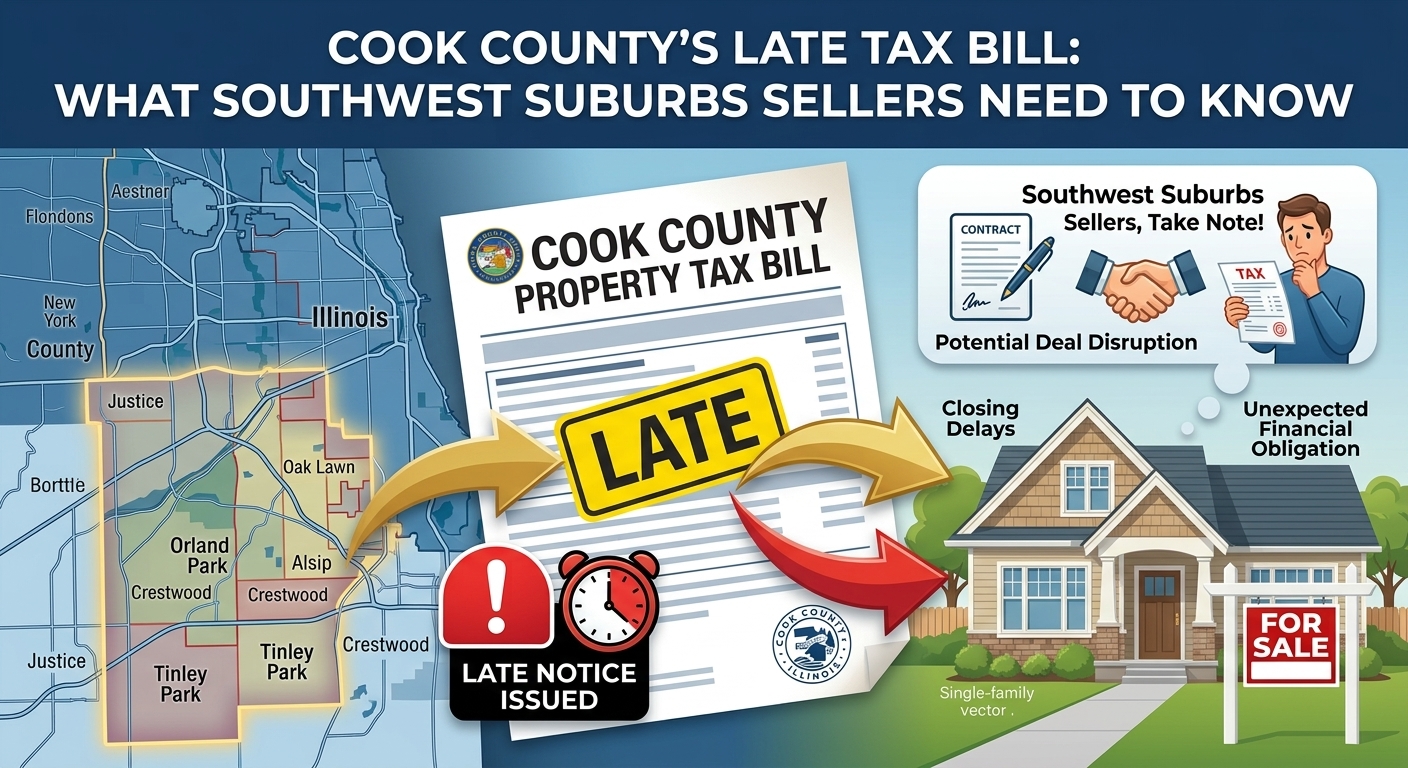
Cook County's Late Tax Bill: What Southwest Suburbs Sellers Need to Know
Cook County Taxes, Property Tax Proration, Southwest Suburbs Closing, 2026 Tax Bill Due, Reassessment Impact, Real Estate Closing Issues
The 2026 Cook County property tax schedule is creating confusion for buyers and sellers across the southwest suburbs. If you’re planning a fall closing in Cook, Will, or DuPage County, understanding how the late second installment bill and the 2026 reassessment cycle affect property tax proration is critical to avoiding expensive surprises.
When Cook County’s 2026 Property Tax Bills Are Due
For Tax Year 2025, payable in 2026, Cook County uses its usual two‑installment system, but the second installment timing is pushing key information dangerously close to fall closings. According to the Cook County Treasurer, the first installment of 2026 Cook County taxes was due on Wednesday, April 1, 2026, at 55% of the prior year’s bill. The second installment is due Thursday, October 1, 2026, with bills released on September 1, 2026 once final assessments and tax rates were certified (cookcountytreasurer.com; cookcountyil.gov).
That September mailing means many September and October closings in the southwest suburbs will occur just as the final 2026 numbers become available—or, for earlier fall contracts, before anyone has seen the true tax bill at all. This is where Cook County Taxes and Property Tax Proration become a real negotiation point instead of a simple line item.
How the Delay Affects Fall Closings in the Southwest Suburbs
In a typical year, second installment bills arrive early enough that title companies and attorneys can use the actual tax figures for Southwest Suburbs Closing calculations. With a September 1 release and an October 1 due date, many fall transactions in Orland Park, Tinley Park, Palos, Lemont, and surrounding townships will either:
Close before the final second installment bill is known, forcing everyone to estimate, or
Close in the narrow window between bill release and due date, leaving little time to adjust contracts or loan figures if the bill is higher than expected.
The result is more Real Estate Closing Issues: re‑drafted settlement statements, last‑minute disputes over who pays what, and, in some cases, delayed closings when parties cannot agree on fair Property Tax Proration.
Reassessment Impact: Why 2026 Prorations Are So Tricky
The 2026 reassessment cycle is hitting many south and southwest Cook County townships with significant value increases—median assessment jumps of roughly 20%–27% in areas like Lemont, Lyons, Palos, Berwyn, Worth, and Bremen, with Calumet seeing smaller but still meaningful changes (cookcountytaxappeal.com). When assessed values climb, tax bills often follow, even if tax rates adjust.
Traditionally, title companies in Cook County might prorate at 105%–110% of the prior year’s bill to protect buyers from modest increases (lysinski.com). In a sharp reassessment year, that cushion may not be enough. The Reassessment Impact means that using last year’s tax bill—even with a small percentage bump—can dramatically understate the real 2026 liability. That gap is the heart of the current proration problem.

Misjudged prorations can leave buyers with hundreds or thousands in unexpected tax costs.
The Proration Problem Caused by the Late 2026 Bill
When the actual second installment bill is not yet available, prorations must be based on estimates. With a late bill and a major reassessment, two things can happen:
If estimates are too low, buyers inherit a larger share of 2026 taxes than intended, effectively subsidizing the seller’s occupancy period.
If estimates are too high, sellers may feel they overpaid, especially if they moved out months before closing.
Because Cook County’s 2026 second installment is both late and based on fresh reassessment numbers, the usual “good enough” rules of thumb for Cook County Taxes may fail. That’s why many attorneys are now recommending more conservative and customized Property Tax Proration strategies for 2026 deals.
Verify Assessment Data Before You Sign
With reassessment in play, the importance of verifying assessment data cannot be overstated. Before you finalize a contract in 2026, both buyers and sellers should:
Pull the latest assessed value and classification from the Cook County Assessor’s website for the specific property and township (cookcountyassessor.com).
Confirm whether a 2026 reassessment notice has already issued and whether an appeal is pending or still possible.
Compare the new assessed value to prior years to gauge how aggressively taxes may rise, keeping in mind township‑level increases of 20% or more in many southwest suburbs.
Buyers should also ask whether the seller has appealed or plans to appeal. An ongoing or potential appeal can affect future tax bills and may need to be addressed in the contract, especially if a successful appeal benefits the buyer after closing.
Considering Escrow Holdbacks to Protect Both Sides
One of the most effective tools for handling uncertain 2026 taxes is an escrow holdback. Instead of guessing high or low, the parties agree that the seller will deposit an additional sum with the title company—often a set percentage above the estimated tax share. Once the actual second installment bill is known and paid, any unused portion is released back to the seller.
In a year with a late 2026 Tax Bill Due date and volatile reassessment results, escrow holdbacks can:
Give buyers confidence they won’t be stuck with a surprise tax spike for the seller’s occupancy period.
Prevent sellers from overpaying by allowing precise reconciliation once the exact bill is issued.
What Buyers and Sellers Should Do Before Signing in 2026
To minimize Real Estate Closing Issues tied to the late 2026 bill, both sides should take a few proactive steps before signing a contract:
Get your attorney involved early. Ask them to review the standard tax proration clause and recommend a percentage that reflects the property’s township, reassessment increase, and timing of the 2026 Tax Bill Due dates.
Specify how prorations will be adjusted if actual 2026 bills differ significantly from the estimate—will there be a post‑closing true‑up, or is the closing statement final?
Discuss escrow holdbacks up front. Especially for late‑summer and fall contracts, make clear in writing whether an escrow will be used and how it will be calculated and released.
Confirm municipal and county differences. If you’re buying near the county line, ask your team to compare Cook County’s delayed cycle with Will or DuPage so you understand why prorations may look different from prior moves.
How Cook County’s Delay Affects Will and DuPage County Closings
While the late second installment is a Cook County issue, it still influences expectations in neighboring Will and DuPage Counties. Many buyers moving within the southwest metro area compare deals across county lines. They may wonder why Cook County contracts call for higher proration percentages or escrow holdbacks when their Will or DuPage purchase did not.
For agents and attorneys, that means clearly explaining that:
Cook County’s accelerated, two‑installment system and delayed final billing create more uncertainty than many collar counties experience (tax.illinois.gov).
The 2026 reassessment spike is particularly pronounced in the south and southwest Cook townships, so Southwest Suburbs Closing strategies may look more conservative than a similar transaction in Will or DuPage.
Final Thoughts: Don’t Treat 2026 Like a Normal Tax Year
Between the delayed second installment and the sharp Reassessment Impact, 2026 is not the year to rely on “standard” tax proration language or assumptions. Buyers and sellers in Cook County’s southwest suburbs—and those comparing properties in Will and DuPage—should approach Cook County Taxes with eyes wide open, armed with current assessment data, realistic estimates, and, when appropriate, well‑structured escrow holdbacks.
With the right preparation and guidance from your real estate attorney and agent, you can navigate the 2026 tax bill delay, avoid unpleasant surprises at the closing table, and make sure your Property Tax Proration is as fair and accurate as possible.
Frequently Asked Questions
When are Cook County's second-installment property tax bills due in 2026?
The second installment of the 2025 tax year bill is expected to be mailed by September 1, 2026, with payment due October 1, 2026, about two months later than the typical August 1 deadline.
Why are Cook County property tax bills late again in 2026?
Cook County has attributed the delay to an ongoing technology overhaul of its property tax system, the same disruption that pushed last year's bills behind schedule as well.
How does a late tax bill affect my closing if I'm selling my house this fall?
Your closing attorney prorates property taxes between you and the buyer using an estimated multiplier, since the actual bill usually isn't available yet. In Cook County, that proration is typically final once you close, so an outdated multiplier, especially in a township hit by the 2026 reassessment, can leave one side absorbing a bigger gap than expected.
Can I ask for a tax proration holdback instead of a final estimate at closing?
Yes, in some cases. It isn't standard on every Cook County deal, though your attorney can negotiate an escrow holdback tied to the actual bill amount rather than treating the estimate as final. This is worth raising directly if your township was reassessed this year.
Will my property tax bill go up because of the 2026 reassessment?
It depends on your township. Orland, Bremen, Palos, Lemont, and several other south and southwest suburb townships are part of the 2026 reassessment cycle, and this delayed bill is the first one to reflect those new values for many owners.
About the Constellation Home Sales Team
The Constellation Home Sales Team — Steve Roake and Kimberly Genovese — has closed more than 615 transactions worth over $113 million across Chicago's southwest suburbs and Northwest Indiana. Licensed since 2003 and operating under Keller Williams Preferred Realty, the team specializes in probate and estate sales, expired listings, negotiation, and divorce and life-transition sales, with a track record of selling homes at 101% of list price against a 97.7% MLS-wide average. Connect with the team at freedomgroupglobal.com or 630-912-9129.
